Robotic Pool Cleaners
Take the work out of pool cleaning with a cordless robotic cleaner! These clever machines clean your pool independently of your pump and filtration system, helping keep your pool clean with minimal effort.
With so many robotic pool cleaners on the market, choosing the right one can be tricky. Based on our experience, their proven quality, reliability, and positive feedback from our customers, we recommend Zodiac and BWT .
Explore our recommended models below, compare features, and use our guide to help you choose the cleaner that best suits your pool and needs.
Robot Cleaner Comparison Guide
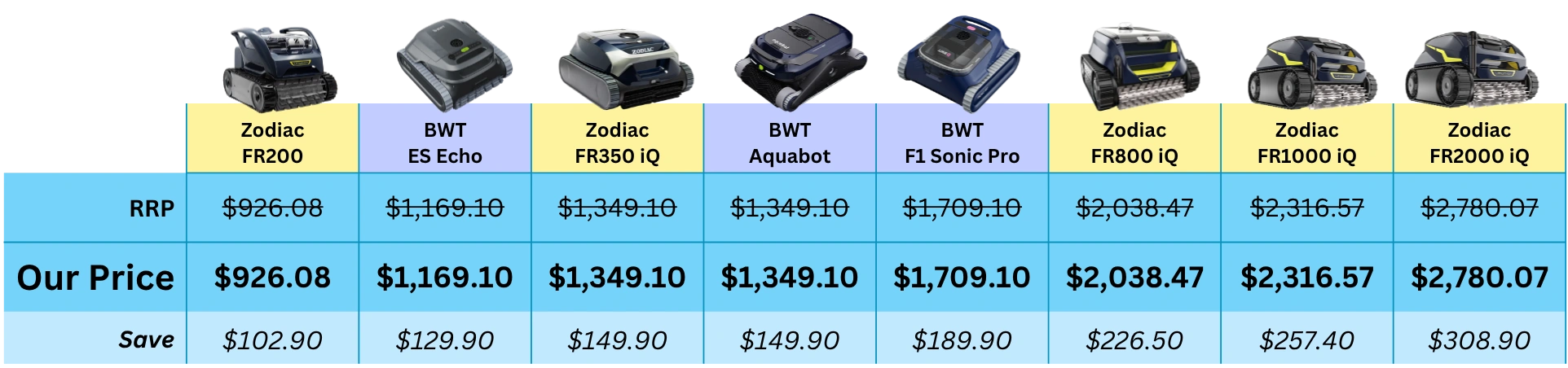
Save with Perth Pools
Choosing the Right Robotic Pool Cleaner
Cordless robotic cleaners operate independently of your pool's pump and filtration system, collecting dirt and debris in their own removable filters.
Although they work in much the same way, models differ in their cleaning abilities, filtration and convenience features. Understanding these differences will help you choose the right cleaner for your pool, needs and budget.
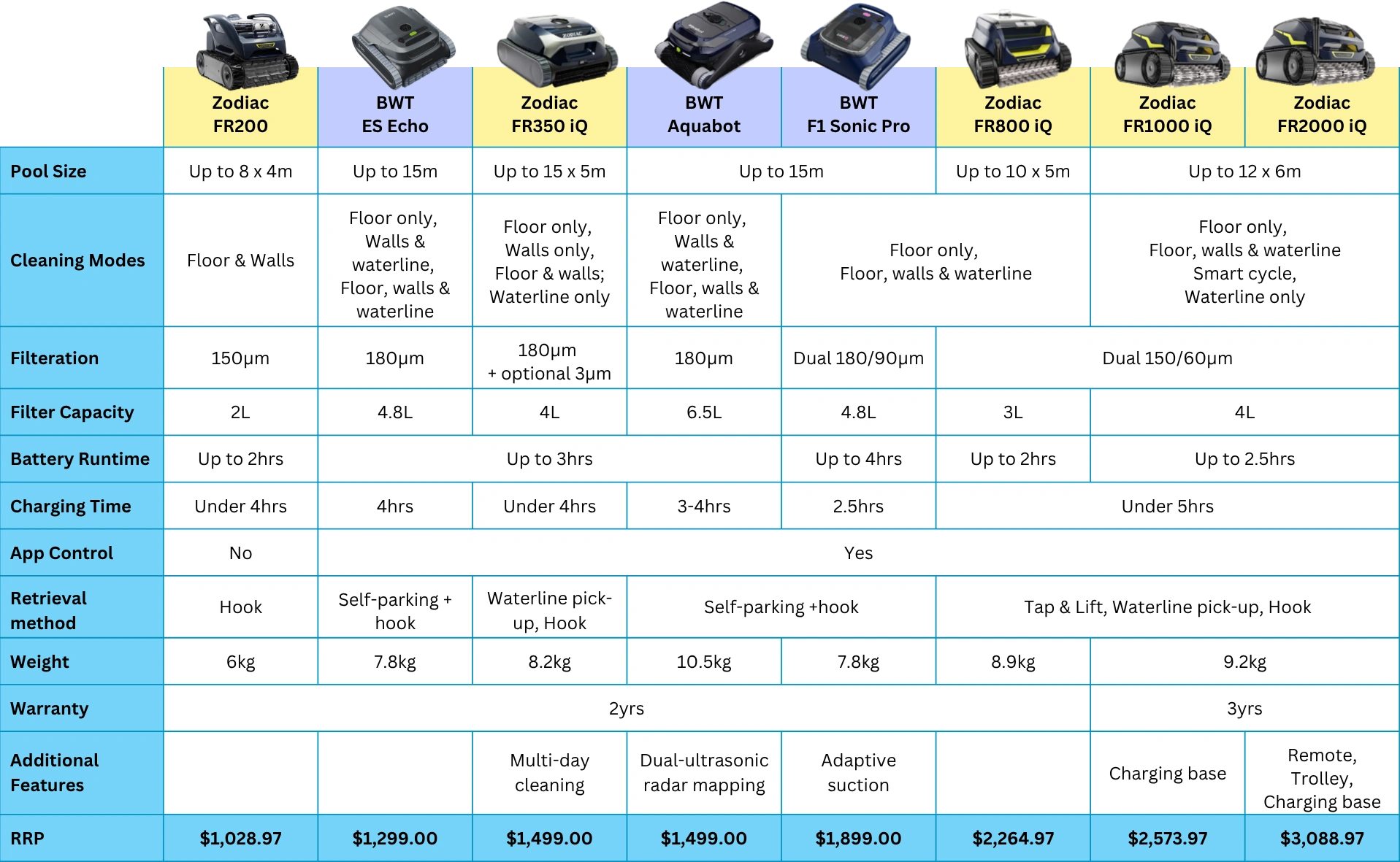
Pool size: Each cleaner has a recommended maximum pool size. Choosing a suitable model helps ensure it can cover your pool during a cleaning cycle. Bigger isn't necessarily better!
Pool shape and surface: Most cleaners suit a variety of pool shapes and surfaces, including concrete, fibreglass and tiles. Some manual brushing may still be needed for areas such as steps, seats and ledges, depending on your pool's design.
Most robotic cleaners clean the floor and walls, while many also clean the waterline, where oils and dirt can accumulate.
Some cleaners have one automatic programme, while others let you choose specific areas:
Floor only: Focuses on dirt and debris settled on the pool floor.
Walls only: Concentrates on the vertical pool surfaces.
Floor & walls: Cleans the pool floor and walls.
Walls & waterline: Cleans the walls and along the water's surface.
Floor, walls & waterline: A full cleaning programme covering all three areas.
Waterline only: Focuses on the waterline, where oils and dirt can accumulate.
Smart cycle: Automatically determines how long to clean based on your pool, rather than using a fixed cleaning time.
Which do you need? For many pools, a full cleaning programme is sufficient. Additional modes offer flexibility for targeted cleaning.
What do the numbers mean? Filtration is measured in micrometres (µm), or microns. Smaller numbers mean finer filtration. For example, a 60µm filter captures smaller particles than a 180µm filter.
Is finer better? Filters around 150–180µm are suitable for everyday dirt, leaves and larger debris. Finer filtration, such as 60–90µm, captures smaller particles and can be particularly useful for pools that collect fine dust or sediment. Ultra-fine filtration, such as 3µm, captures even smaller particles but may require more frequent cleaning.
What is dual filtration? Dual filtration uses two filter layers together. The coarser layer collects larger debris first, helping prevent the finer layer from clogging too quickly as it captures smaller particles. Some cleaners also offer optional finer filters.
Does filter capacity matter? Capacity is measured in litres (L). A larger filter can hold more debris before needing emptying, making it particularly useful for pools surrounded by trees. However, all filters still need regular cleaning.
Is longer runtime better? Not necessarily. Battery runtime is the maximum operating time per charge, while individual cleaning programmes may run for shorter, preset durations depending on the model and selected mode. Navigation systems help the cleaner cover the chosen areas efficiently during each cycle.
Efficient navigation and cleaning can be more important than simply running longer, which helps explain why some more expensive models have shorter advertised runtimes.
Charging between cleans: Cordless cleaners typically take 2.5–5 hours to recharge. Robotic cleaners should be removed from the pool once their cleaning cycle is complete, rather than being left in the water between uses. This gives you plenty of opportunity to recharge your cleaner between uses.
Getting started: Simply lower the cleaner into the pool by its handle, allowing it to fill with water and release any trapped air before settling on the pool floor. Depending on the model, cleaning programmes are selected and started using controls on the cleaner or through an app.
Retrieving your cleaner: After a cleaning cycle finishes, robotic cleaners have different ways of positioning themselves for removal from the pool.
Hook: The cleaner stops wherever it finishes its cycle. Attach the retrieval hook to your existing pool pole to reach and lift it from the water.
Self-parking + Hook: The cleaner automatically moves to the pool wall at the end of its cycle, making it easier to reach using the retrieval hook.
Waterline pick-up: The cleaner automatically climbs to the waterline towards the end of its cleaning cycle and waits for you to lift it out by the handle. App-connected models can notify you when it's ready. If not collected, it returns to the pool floor, where it can be retrieved using the hook.
Tap & Lift: Tap the cleaner with your pool pole to activate its climb to the waterline for easy removal.
Remote retrieval: Use the handheld remote to direct the cleaner to a pool wall and activate its climb to the waterline, where you can lift it out by the handle.
6. Apps, Navigation and Additional Features
App control: Depending on the model, apps can let you select cleaning programmes, schedule cleaning, check progress, receive notifications and activate retrieval functions. Most cleaners can also be operated directly without an app.
Dual-ultrasonic radar mapping: Uses two ultrasonic radars to scan the pool, detect obstacles and plan efficient cleaning paths.
Multi-day cleaning: Splits one battery charge into several shorter floor-cleaning sessions over multiple days, without recharging between sessions.
Adaptive suction: Adjusts suction power according to debris levels.
Charging base: A dedicated charging station that allows you to simply place the cleaner onto the base to recharge, rather than plugging a charging cable directly into the cleaner.
Transport trolley: Allows you to wheel the cleaner to and from the pool edge, making it easier to move and store. The FR2000 trolley also holds its charging base.
Handheld remote: Allows control of certain functions without a phone.